

Whey Protein Prices: How Are Consumers Responding?
Whey protein has become a key part of the sports nutrition market, but rising prices are creating new challenges for brands and consumers.
With the cost of whey increasing, brands are looking at different ways to manage the impact, from changing pack sizes and pricing through to reformulating products and exploring other protein sources.
But how are consumers responding to these changes?
We conducted UK consumer research through Vypr to find out whether people have noticed the increase in whey protein prices and, if so, whether it is changing the way they shop.
Have consumers noticed the price increase?
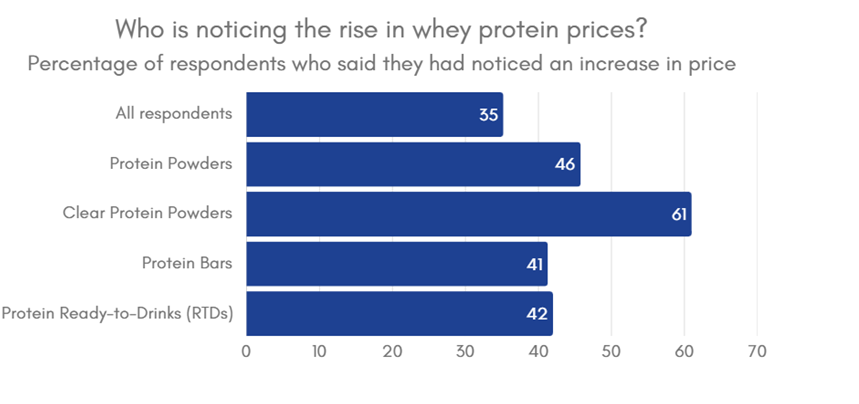
Of the 506 consumers surveyed, 35.4% reported noticing an increase in the price of whey protein products.
A further 41.1% said they had not noticed an increase, while 23.5% were unsure.
We saw a further split between users of different protein sources. 62% of clear protein users said they had noticed price increases, compared to only 42% of protein bar & RTD users.
This suggests that consumers are more aware of these price changes in their larger, bulk purchases compared to one-off impulse buys of smaller servings.
While awareness isn’t universal, the behaviour of those who have noticed the change tells a more interesting story.
How are purchasing habits changing?
Among the 179 consumers who had noticed the price increase, 86% said it had changed the way they buy whey protein products.
The most common response was to wait for discounts or special offers, with 28.5% selecting this option.
Other changes included:
- 22.9% buying whey protein less often
- 19.6% looking for cheaper options
- 11.7% buying smaller quantities
- 3.4% stopping buying whey protein altogether
Only 14% said they continued buying whey protein in the same way as before.
This suggests that rising prices aren’t necessarily pushing consumers away from whey protein altogether. Instead, many are finding different ways to manage the cost, whether that’s waiting for promotions, buying less frequently or looking for more affordable products.
Are consumers considering other proteins?
Price could also be opening the door to other protein sources.
When asked whether they had considered buying a different type of protein because of the price of whey, 39% said yes.
Among those considering alternatives, protein blends were the most popular choice at 33.5%, followed by plant-based protein at 29.9% and milk protein at 23.9%.
This is particularly interesting as the industry is also looking at ways to reduce reliance on whey, including blended and alternative protein formulations.
How are brands responding?
For brands, rising whey prices mean looking beyond simply increasing the price of the finished product.
The market is already seeing a range of responses, including changes to pack sizes, reduced promotions and reformulation. There is also growing interest in products that combine different protein sources.
Smaller pack sizes can help brands maintain a more accessible price point, while reformulation can provide another way to manage the amount of whey used in a product.
Protein blends are particularly interesting in this context. They can bring together different protein sources to create a formulation that meets nutritional and commercial requirements, while potentially reducing reliance on whey.
But what happens to taste?
Changing the protein source isn’t simply a case of swapping one ingredient for another.
Different proteins can have an impact on the sensory profile of a product, including flavour, mouthfeel, sweetness perception and aftertaste.
For brands, this means that reformulation needs to consider more than just the nutritional specification and cost of the finished product.
Consumers still expect products to taste good.
As protein formulations change, maintaining the taste and overall experience of the original product becomes an important part of successful reformulation.
What could this mean for the protein category?
The rise in whey prices could be more than a short-term challenge. It may be encouraging both consumers and brands to rethink how protein products are bought and formulated.
Our research shows that consumers who have noticed the price increase are already changing their purchasing habits, with some also considering different protein sources.
At the same time, brands are exploring new pack formats, reformulation and protein blends as they look for ways to respond to changing costs.
Rather than signalling the end of whey, this could lead to a more diverse protein market, with different protein sources being used together to deliver the right balance of nutrition, cost, functionality and taste.
For or product developers, the challenge will be finding that balance while continuing to give consumers a reason to choose the product.
Exploring alternative protein sources?
Whether you’re experimenting with different protein sources as an alternative to whey, or developing blends that combine whey with other proteins, changes in formulation can bring new taste and sensory challenges.
From managing off-notes and bitterness to creating a balanced flavour profile, Synergy can help brands develop flavour solutions that support protein innovation without compromising the consumer experience. Want to know more about how flavour can support protein reformulation and innovation? Get in touch with the Synergy team
Reference List
Synergy Flavours / Vypr (2026).Consumer research: Whey protein products price increase. UK consumer research, August 2026
Carbery (2025).Annual Report 2025 – Nutrition Business Review: https://www.carbery.com/wp-content/uploads/2026/04/28.3.25-2025-Report-WEB-2.pdf
Carbery.Performance Nutrition – The perfect balance of taste and performance: https://www.carbery.com/nutrition/market-focus/performance-nutrition
Carbery.Insight & Innovation – Explore the latest insights and innovation in whey protein: https://www.carbery.com/nutrition/insight-innovation/
Carbery.Nutrition Insights: https://www.carbery.com/nutrition/nutrition-insights/
Myprotein (2026).Impact Whey Protein Powder: https://www.myprotein.com/p/sports-nutrition/impact-whey-protein-milkshake/17755445/
insights